Specialty · Wine column & dual-zone
Why is my Sub-Zero wine column drifting off temperature?
A Sub-Zero wine column that wanders a few degrees off its setpoint in an Alameda kitchen is rarely a dead cabinet — it is usually a thermistor reading off, a stuck damper, or a condenser losing airflow, with a sealed-system loss as the rarer last suspect. Out here on the East End the marine air loads the cabinet with humidity that ages seals and corrodes the coil, so drift shows up sooner. Because these columns sit deep in tight cabinetry, the built-in cabinet removal and reseat carries real risk to original millwork — which is why we measure first. Call and we will help you decide before anything moves.
Why does my Sub-Zero wine column drift off its set point in Alameda?
Alameda Sub-Zero Repair logs an independent probe against the panel over a full cycle to catch which dual-zone set-point has drifted, pointing to a thermistor or a stuck damper long before a sealed-system loss. We serve Bay Farm Island across the bridge in 94502; call (510) 390-9712 today.
Why a wine column is not a mini-fridge to diagnose
A Sub-Zero wine cabinet is engineered to hold a narrow band — often a red zone and a white zone independently — within a degree or two, with low vibration and managed humidity so corks and labels survive. A two-degree wander you would never notice in a kitchen refrigerator is the whole complaint here, because slow heat is what damages a collection. So the diagnosis is about the control loop, not just "is it cold": which thermistor is reporting, whether a damper is metering air between zones, and whether the sealed system still pulls the cabinet down on demand.
Alameda homes complicate this. These columns are usually integrated flush into custom cabinetry with little clearance front or rear, so reaching the evaporator, fan, or control board often means a built-in cabinet removal — and the reseat has to land the unit back into millwork without scuffing a panel or pinching a water line. That removal-and-reseat risk is real, which is why we exhaust every in-place measurement first and only pull the cabinet when the evidence makes it necessary.
Five ways a Sub-Zero wine column drifts
Each of these starts with the same complaint — "the temperature is off" — and ends somewhere very different. The card names the symptom, what the diagnosis confirms, the likely part, and what actually moves the quote.
Thermistor reading off
Symptom: display and bottles disagree. Diagnosis: resistance check plus an independent probe trace. Part: zone thermistor. Quote moves with: single vs. dual-zone access.
Stuck or mistracking damper
Symptom: one zone holds, the other runs warm. Diagnosis: watch it actuate on a logged cycle. Part: damper assembly or motor. Quote moves with: whether the board also drives it.
Condenser coil packed with dust or pet hair
Symptom: runs hot, slowly warms. Diagnosis: airflow and condenser inspection. Part: often none — a clean restores it. Quote moves with: whether a fan also failed.
Door gasket leak, condensation or frost line
Symptom: sweating glass, a frost edge. Diagnosis: seal-compression check. Part: magnetic gasket, correct profile. Quote moves with: alignment and hinge wear.
Evaporator fan slowing
Symptom: uneven shelves, top warm. Diagnosis: fan operation and current draw vs. spec. Part: evaporator fan motor. Quote moves with: generation and any ice bind.
Sealed-system loss
Symptom: won't reach setpoint, runs constantly. Diagnosis: EPA-certified leak and pressure test. Part: sealed-system repair. Quote moves with: cabinet age vs. parts availability.
| What you notice | Likely component | Confirm with | Don't assume |
|---|---|---|---|
| Display off, cabinet still cold | Thermistor | Resistance + independent probe | Not a dead control board |
| One zone warm, one holds | Damper / actuator | Watch it actuate on a cycle | Not always a refrigerant loss |
| Runs hot, slow to recover | Fouled condenser | Airflow + coil inspection | Often no part needed |
| Glass door sweats / frost line | Door gasket | Seal-compression check | Not the chiller failing |
| Won't reach setpoint at all | Sealed system | EPA-certified leak & pressure test | Not a refrigerant "top-off" |
The condenser case deserves a plain word, because it's the most common and the most over-diagnosed. "Packed with dust or pet hair" means exactly that: the coil that dumps the cabinet's heat is buried under a felt of lint, dander, and the fine salt grit Alameda air carries, so it can't shed heat and the compressor runs hot and long. A diagnosis confirms it by inspecting the coil and measuring airflow and run time against spec — and the honest limit is this: we cannot know from the outside whether a long-overheated unit has only a dirty coil or has also tired a fan motor or stressed the sealed system. That takes a live measurement once the cabinet is open, which is why we won't quote the part list before we inspect.
Schedule, pause, or just send a photo?
Schedule service when…
- The reading is off by a couple of degrees but the cabinet still feels cold and steady.
- One zone wanders while the other holds — a sensor or damper question, not an emergency.
- The glass door has started to sweat or show a faint frost line.
Pause use and move bottles when…
- The cabinet is climbing toward room temperature, not just reading wrong.
- It cycles hard, never settles, or throws a temperature alarm.
- You smell warmth or hear the compressor running without pause.
A door gasket leak is evidence, not opinion
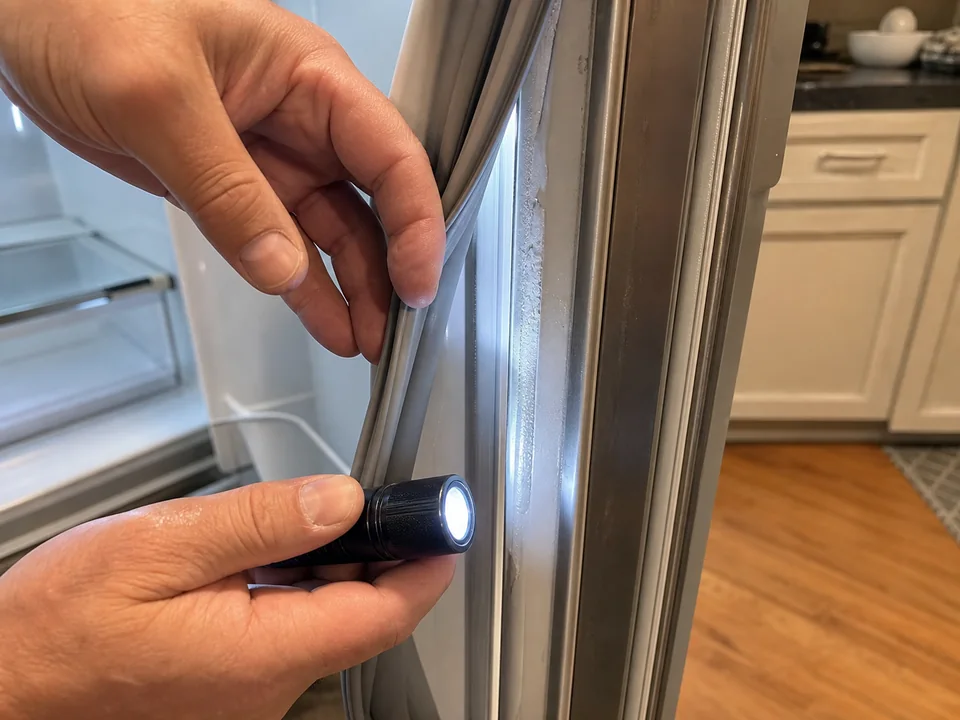
When a wine column shows condensation, a sweating glass door, or a frost line at the seal, we don't guess the gasket is the cause — we prove it. The technician documents temperature readings, condenser/evaporator photos, model-tag proof, and factory-authorized OEM fan/gasket/control-board evidence, so a recommended seal replacement is backed by what was measured rather than a sales pitch. A stiffened magnetic gasket letting humid Bay air slip past is a common, honest fix here — but it earns its place on the invoice only after the seal-compression check and the logged trace agree.
Verify wine-column drift before a visit — 4 steps
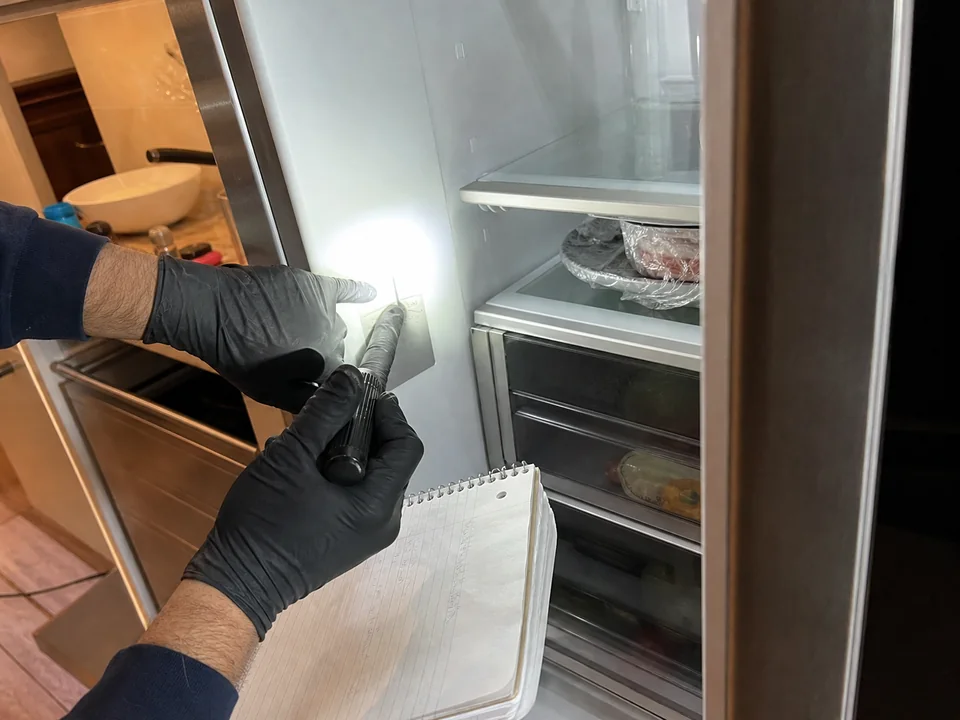
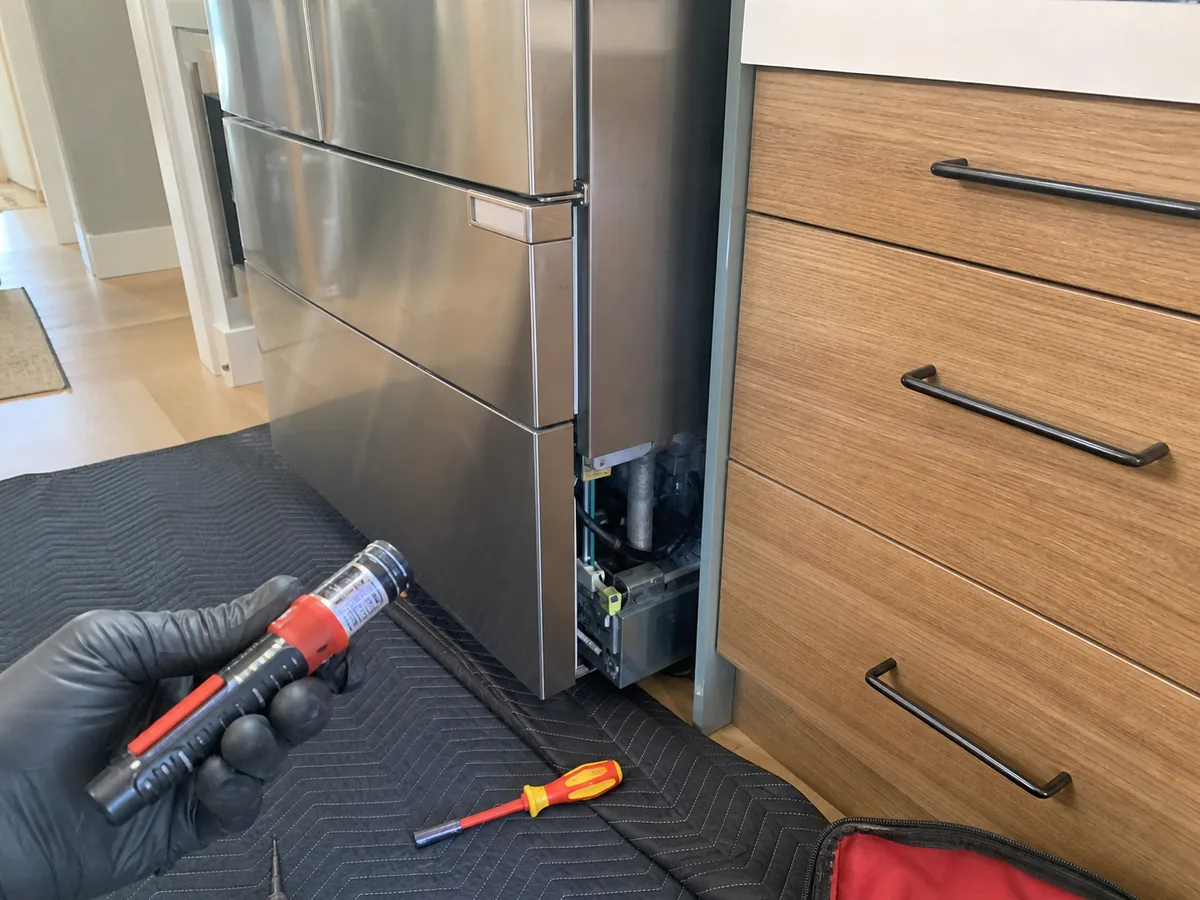
A front panel can read off while the cabinet is fine, or read fine while the wine warms. These steps confirm real drift before anyone touches the column.
Put an independent thermometer on a shelf
A standalone thermometer on the shelf for an hour shows what the wine actually sees, not just what the panel claims.
Compare it to the setpoint and panel
A repeatable gap of more than 2–3°F between the probe and the display points to a thermistor or damper, not a setting.
Note which zone drifts on a dual cabinet
On a dual-zone column, record whether the reds, the whites, or both are off — it isolates the sensor or damper.
Photograph the rating plate
The serial fixes which thermistor, damper, or board your column generation uses, so the right factory-authorized OEM part rides on the van.
What a Sub-Zero wine-column repair tends to cost in Alameda
A thermistor, damper, gasket, or evaporator fan on a wine column lands in a mid range; sealed-system work is the priced-apart exception. The table lists typical Alameda estimates; your real number is set on site once the model and serial are confirmed.
| Service / symptom | What's included | Price range | Timeframe |
|---|---|---|---|
| Diagnostic / service call | On-site logged probe trace, model & serial confirmed, written findings (credited) | $115–$185 | Same visit |
| Zone thermistor | Zone sensor replaced, verified against an independent probe trace | $225–$425 | 1 visit |
| Damper assembly / actuator | Stuck or failed zone damper replaced and re-calibrated | $285–$545 | 1 visit |
| Door gasket & alignment (glass door) | factory-authorized OEM gasket and alignment to stop sweat and frost on the glass | $235–$420 | 1 visit |
| Evaporator fan motor | factory-authorized OEM fan motor, zone airflow and recovery confirmed | $345–$645 | 1 visit |
| Sealed system / compressor (EPA) | When a zone truly won't hold setpoint and refrigerant is proven lost | $1,750–$3,450 | 1–2 visits |
Typical Alameda estimates, not a quote.
What determines the final price: single- versus dual-zone access, whether the cabinet must be eased out of tight millwork, and whether the drift is one component or a sealed-system question. Repair vs. replace walks when a new cabinet wins.
Where you store changes the call
Alameda is small, but a wine column behaves differently block to block — and the neighborhood often tells us as much about the access and the likely fault as the model number does.
Period homes, flush millwork
Grand Victorians where a column is set into original cabinetry near the dining room — clearances are tight, condensers foul faster, and any pull has to protect the casework.
1920s bungalows, retrofit kitchens
Older flats where a wine cabinet shares a wall with plumbing and the access path is half the job; humidity here ages the door gasket sooner than the spec sheet predicts.
Newer builds, panel-ready columns
Across the bridge on Bay Farm, integrated columns dominate the newer kitchens; the open, humid waterfront air is what drives gasket sweat and damper drift on these cabinets.
Waterfront humidity
Close to the estuary in Fernside, salt-laden marine air is hardest on seals and condenser coils, so on those calls we budget extra time for gasket and corrosion checks first.
Drifting a few degrees? Let's read it before it moves anything.
Tell us the setpoint, what an independent thermometer reads, and send a photo of the rating plate. We'll confirm whether the likely part is in stock for an Alameda visit before the cabinet is ever touched.
Related Sub-Zero pages
The sealed system
If the column truly won't reach setpoint, the diagnosis moves to refrigerant and the compressor. See sealed system & compressor for how that verification works.
Door gaskets & seals
Sweating glass and a frost line usually trace to the seal. Read door gasket & seal repair for the compression check and gasket profiles.
Start here
New to the symptom? The main Sub-Zero repair page maps every cold-side fault, and the booking page shows what to send.
Wine storage temperature questions
My Sub-Zero wine column drifted two or three degrees — is that a real problem?
It can be. A few degrees off setpoint over a long period can cook delicate bottles, and the drift usually traces to a thermistor reading off, a stuck damper, or a fouled condenser before it's ever a sealed-system loss. We log an independent temperature trace over a cycle to find out which, rather than trusting the front panel alone.
Should I keep storing wine while the column is drifting?
If only the temperature reading looks slightly off but the cabinet still feels cold and steady, you can usually keep the bottles in place and schedule service. If the column is warming, cycling hard, throwing an alarm, or sweating at the door, move irreplaceable bottles to a cool, dark place and pause use until it's diagnosed.
What should I send before a wine column service visit?
Photograph the model and serial rating plate, note the setpoint you've programmed and what an independent thermometer reads, and tell us whether it's a single-zone or dual-zone cabinet. That lets us confirm which thermistor, damper or control board your generation uses before the visit. The model & serial guide shows where to look.
What temperature should a Sub-Zero wine column hold, and how much drift matters?
Most owners set reds around 55–60°F and whites around 45–50°F, often in two zones. A steady reading within a degree or two of setpoint is fine; a repeatable drift of more than 2–3°F is worth diagnosing, because sustained warmth cooks delicate bottles. We log an independent probe over a cycle to confirm real drift versus a panel that simply reads off.
How much does a Sub-Zero wine column repair cost in Alameda?
Most wine-column repairs in Alameda run $225–$645 — a zone thermistor, a damper, a glass-door gasket, or an evaporator fan — plus a $115–$185 diagnostic credited to the work. Sealed-system work is the exception at $1,750–$3,450. The serial and whether it's single- or dual-zone set the exact number.
Does Alameda's humidity make wine-column glass doors sweat?
Yes. The marine humidity off the estuary — strongest in Fernside, the Gold Coast, and Bay Farm Island — condenses on cold glass when the door gasket has stiffened or the frame heater is weak. Sweat and a faint frost line usually mean a seal or heater issue, not a cooling fault. A gasket and alignment fix runs $235–$420.
Alameda · Sub-Zero owners
What Alameda customers say
Our wine column had crept up a few degrees and the display couldn't be trusted. They logged an independent probe over a full cycle and traced it to a drifting thermistor rather than the sealed system — a fraction of what I feared.
They caught a stuck damper in the lower zone before it cooked the reds — found it by logging both zones against an outside probe rather than trusting the panel. Careful, precise work that genuinely saved the collection.
They knew our dual-zone wine column inside out, read the generation off the serial, and pre-stocked the right control board so there was no second trip. Out here near the water the humidity is rough on these units, and they checked the gasket while they were in.