What does my Sub-Zero error code or alarm actually mean?
Sub-Zero codes are read by model and serial, not from one generic chart. Real behaviors here are a flashing "Service" indicator, a "Vacuum Condenser" reminder, a door-ajar or over-temp alarm, a warm fresh-food side, or a blank display. In Alameda's marine air, damp connectors and corroded leads fake electronic faults, so we verify each by measurement.
Sub-Zero error codes & alarms list (Alameda)
This is a quick-reference list of the alarms a Sub-Zero actually shows, not a chart of made-up numbers. Meanings shift by generation, so where it isn't universal we say verify by model/serial — the exact wording is confirmed against your unit's tag.
| Alarm / display behavior | What it usually points to | What to do |
|---|---|---|
| Flashing or solid "Service" indicator | A stored fault — often a sensor or board reading, not a confirmed board failure | Photograph it, then verify by model/serial; don't swap the board to clear it |
| "Vacuum Condenser" reminder or unusually long run times | A condenser packed with dust — and on Bay Farm and the East End, salt-laden marine air loads coils faster | Pull the grille, clean the condenser, then re-probe before naming a part |
| Door-ajar / over-temp alarm with no obvious gap | A door switch or a gasket stiffened by Alameda's damp coastal fog | Run a paper-drag test on the seal and check the switch before suspecting the control |
| Fresh-food side warm while the freezer still holds | An evaporator fan, defrost fault, or thermistor on that one sealed system | Log compartment temps over a cycle; confirm the fan runs at the door switch |
| Blank, frozen, or unresponsive display | A board, connector, or supply issue — sometimes after a power flicker on older Alameda wiring | Power-cycle once, check the supply, then read service mode; verify by model/serial |
| Newer EC-style coded alerts (touch-control generations) | A specific subsystem the panel flags — meaning is generation-specific, not a universal number | Note the exact text and verify by model/serial; never assume a number's meaning |
How do I read a Sub-Zero error code or alarm in Alameda?
Alameda Sub-Zero Repair reads the code in service mode against your model and serial, then measures the suspect circuit before naming a part, because the same alarm can trace to a thermistor, fan, or defrost fault, not the board. We serve the East End and 94502 Bay Farm side; call (510) 390-9712 today.
What you can safely check — and what needs a trained tech
A code on the display is not an invitation to open the sealed system. There are a few honest things an owner can do that won't make the diagnosis worse, and a clear line past which guessing gets expensive or unsafe. The point of this page is to keep you on the right side of that line until a meter is on the circuit.
Low-risk steps that help the diagnosis
Write down the exact code or alarm wording and how often it returns. Confirm the unit has power and the door is closing fully against its gasket, since a door-ajar alarm is sometimes just a tired seal. Note whether one compartment is warm while the other holds, and listen for whether the evaporator fan runs when the door switch is pressed. A photograph of the model and serial tag rounds it out. None of this opens a panel or touches refrigerant.
No unsafe DIY on refrigerant, gas, mains or the control board
Do not open the sealed system, "top off" refrigerant, probe live mains wiring, or swap a control board to clear an alarm. Refrigerant work is EPA-regulated, mains and board terminals carry current that can damage the very part you are trying to read, and a board swap on a flagship unit is the most common way a simple sensor fault turns into a costly one. If the code touches the sealed system, electrical supply, or the main control, that is the part of the job that is ours, not yours. And if the alarm arrives with climbing compartment temperatures and a loaded refrigerator, skip the routine queue — that scenario is exactly what our same-day emergency service in Alameda exists for.
Symptom, suspect component, and the test that confirms it
This is a map of how a code is reasoned through, not a universal code chart — Sub-Zero does not use one set of numbers across every model and control generation, so we verify meaning by model and serial. Read across: what the alarm is paired with, the component it usually points at, the test that confirms it, the false positive that fools a fast guess, and where the repair goes.
| Symptom with the alarm | Possible component | Confirmation test | False-positive to avoid | Repair path |
|---|---|---|---|---|
| Temperature alarm, fresh-food warm, freezer holds | Evaporator fan or defrost on one circuit | Compartment temps logged + fan run check at door switch | Assuming the board failed because it raised the alarm | Replace the proven fan or defrost component, re-verify recovery |
| Sensor or probe alarm (verify by model/serial) | Thermistor reading out of range | Resistance check vs spec at known temperature | A good sensor on a damp, corroded connector | Clean/repair connector or replace the OEM thermistor |
| Door-ajar alarm with no obvious gap | Door switch or stiffened gasket | Switch continuity + gasket seal-compression check | Blaming the control before testing the switch | Replace switch or correct-profile gasket, re-seat alignment |
| Both compartments warming with alarm | Sealed system / compressor | EPA-certified leak and pressure test | Reading it as a sensor fault and clearing the code | Documented sealed-system work, never a refrigerant top-off |
| Ice low or slow with a fill/ice alarm | Inlet valve, filter, or fill tube restriction | Logged fill-volume test through a cycle | Condemning the ice module itself | Clear the water-path restriction, replace the proven part |
| Wine zone alarm, drifting several degrees | Thermistor or damper on that zone | Independent probe trace logged over a cycle | Trusting the panel reading alone | Repair the zone sensor/damper, confirm against the probe |
| Intermittent alarm, clears then returns | Connector, harness, or moisture intrusion | Wiggle test + connector inspection under load | Replacing the board to "make the code go away" | Repair the connection; board verified last, not first |
| Alarm only after a power event or brownout | Control logic state or settings reset | Service-mode read + supply-voltage check | Buying a board before checking the supply | Restore settings, confirm stable supply, monitor recovery |
How alarms differ by Sub-Zero model family
Control behavior, the way an alarm is shown, and how you enter service mode change between generations. Below is how each line tends to present — not a list of code numbers. Where a meaning depends on the exact unit, it says verify by model/serial, because inventing a number would be worse than admitting it varies.
Built-in dual-refrigeration
Two sealed systems mean an alarm usually belongs to one circuit. A warm fresh-food side with a temperature alarm points at that evaporator or defrost, not the whole cabinet. Exact code wording: verify by model/serial.
Integrated column fridge & freezer
Integrated panels and tight surrounds make door-switch and gasket alarms common — humid air past a stiffened seal reads as a door event. Service-mode entry differs by generation: verify by model/serial.
Professional refrigeration
Heavier condenser duty means thermal and airflow alarms show up when the coil fouls. The display flags temperature, but the cause is often airflow, confirmed before any control work. Codes: verify by model/serial.
Wine storage columns
Zone alarms here are usually a thermistor or damper reading off, not the board. A logged probe trace separates a sensor fault from a real sealed-system loss. Alarm thresholds: verify by model/serial.
Undercounter & ice
Compact units pair ice and fill alarms with water-path restrictions far more often than module failures. The alarm follows the symptom; the fill-volume test names the part. Code set: verify by model/serial.
Sensors, harness & boards
Thermistor, connector, and supply-voltage issues throw alarms that mimic a board fault across every line. The main control board is verified last, by measurement, and only when the circuit ahead of it tests good.
When the alarm follows "fridge warm, freezer fine"
In plain language: a Sub-Zero built-in keeps two separate cooling systems in one cabinet, so the freezer can stay solid while the fresh-food section slowly climbs into the danger zone — and the display raises a temperature alarm describing that drift. The alarm is reporting the warm side, not pointing at the part. What actually confirms it is a logged temperature trace across a full cycle plus a fan and defrost check on that circuit, which tells us whether the evaporator fan stalled, a defrost cycle failed, or a thermistor is feeding the control a bad reading. The honest limitation: until a meter is on the sensor and the fan is observed under load, we cannot know from the code alone whether the board is misreading a good sensor or the sensor itself has drifted — that distinction only appears on site, and it changes the part and the price.
Where this happens in Alameda matters to the visit, too. In the Gold Coast, those grand homes set built-ins into original millwork with almost no clearance, so condensers foul faster, alarms tied to airflow show up sooner, and the unit has to be eased out on glides rather than pulled — work that takes longer and protects period casework. The mix of older homes, narrow side streets that complicate routing a service van and parts, and a high concentration of integrated columns means a Gold Coast call is as much about careful access as it is about the code on the screen. Out toward the East End, 1920s bungalows hide retrofit kitchens where sensor harnesses and water lines snake through tight cabinetry, so an intermittent alarm there is often a connector working loose with the damp, not a failed board — and reaching it cleanly is half the job.
An ice maker that's slow, jammed, or dropping hollow cubes
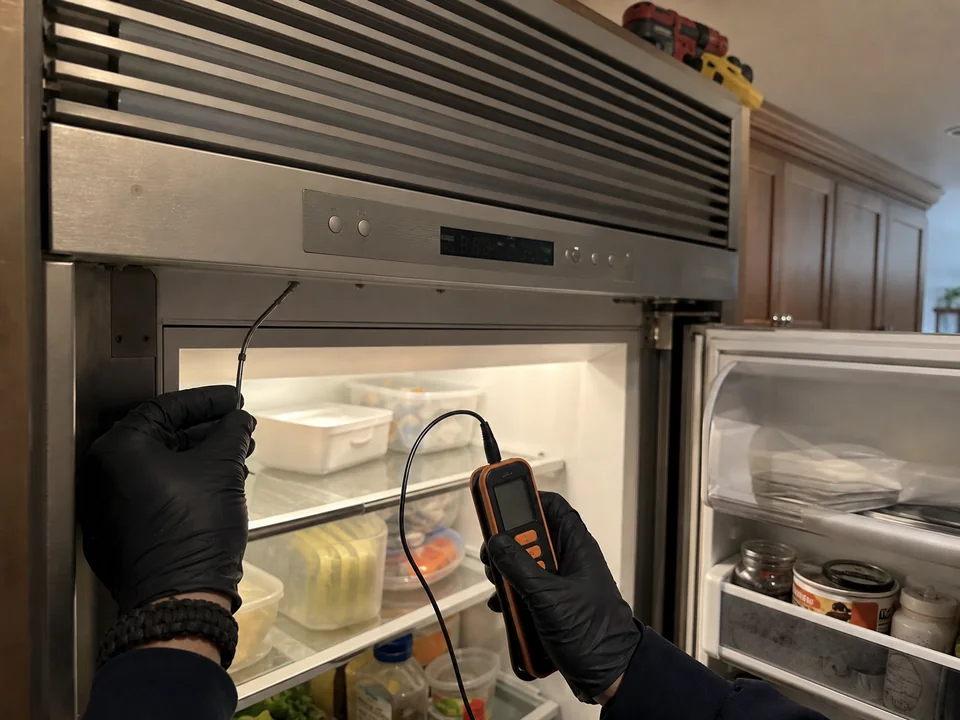
When the alarm pairs with ice that comes slow, jams in the mold, or drops thin, hollow cubes, the fault almost always follows the water — a starved inlet valve, a tired filter, or a kinked fill tube — not the ice module the alarm sits on. We don't take that on faith. The evidence we collect is concrete: temperature readings logged through a cycle, condenser and evaporator photos, model-tag proof matched to your serial, and factory-authorized OEM fan, gasket, or control-board evidence when those circuits are in question. The repair is backed by what we measured, so you can see why the part was named.
The evidence behind every code we clear
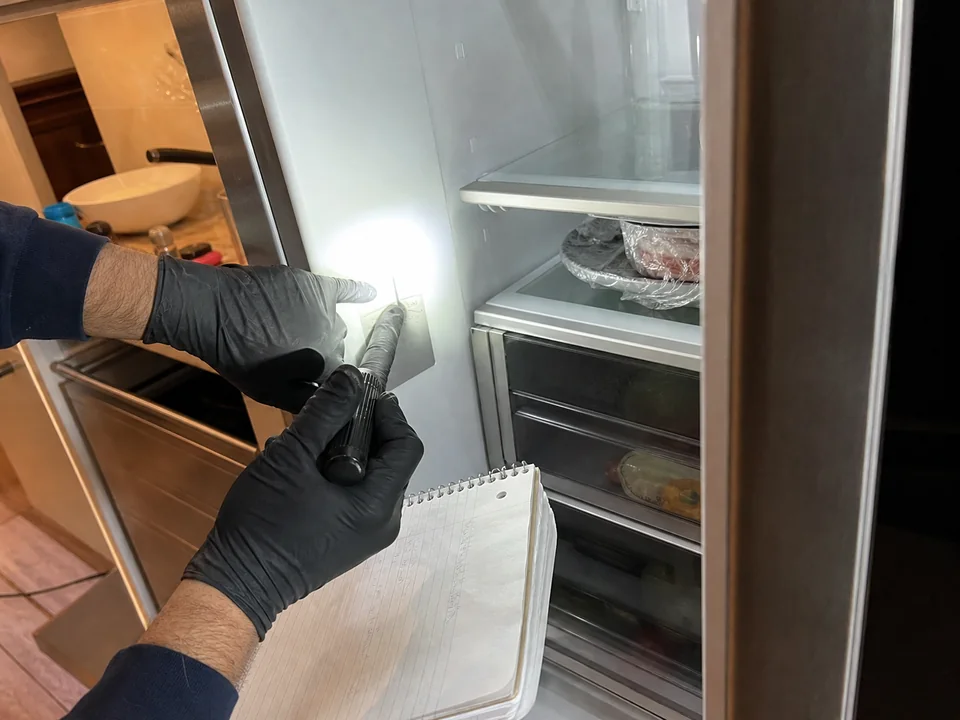
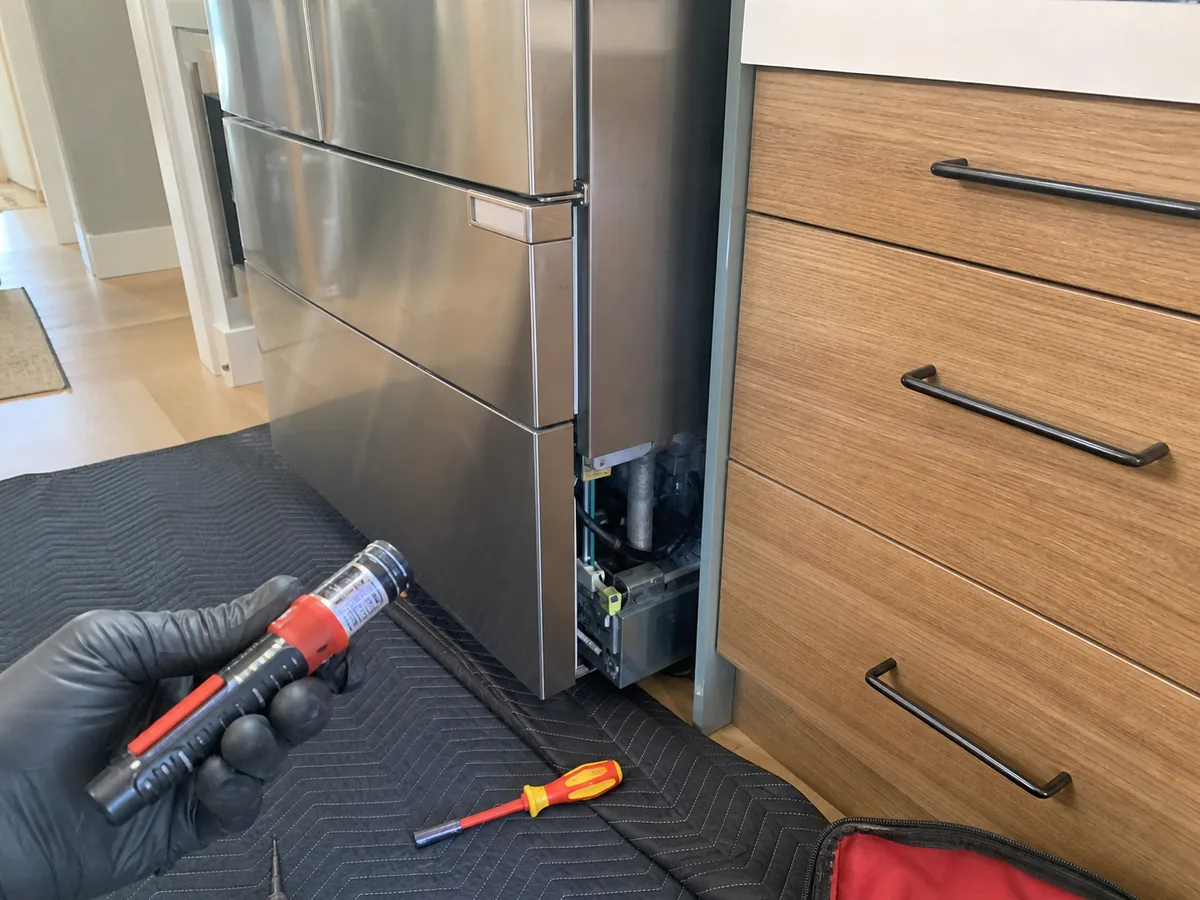
A code is the start of the record, not the end of it. We photograph the model tag so the part fits your generation, read the circuit with a meter or probe so the alarm is matched to a measurement, and document the component itself — so the repair is proof, not a sales pitch.
Read and log a Sub-Zero alarm in four steps
Codes are read by model and serial because their meaning shifts by generation. These steps capture what we need to narrow the circuit before a visit.
Write down the exact code
Note the precise letters and numbers on the display, not a paraphrase; the exact code narrows the circuit.
Note what else is happening
Record whether a compartment is warm, which side, and whether ice or water is involved — the alarm plus the symptom tells more than either alone.
Photograph the display and rating plate
Codes are read by model and serial because meanings vary by generation, so send both images.
Don't clear or reset repeatedly
Repeated resets can hide the pattern and, on some faults, let temperatures drift; leave it and call so we read the service-mode behavior.
We do not guess a code into a part
The board is verified last, not swapped first
An alarm is not a parts order. We will not clear a code by swapping the control board, top off a sealed system because a temperature alarm appeared, or read a generic chart to you as if it were your unit's truth. Every code is confirmed by service-mode behavior and a measurement on the suspect circuit, checked against your model and serial, before a part is named. If the circuit ahead of the board tests good, then and only then is the board on the table.
The table lists typical Alameda estimates by the circuit behind the code, not by the code itself. They are not a quote — your real number is set on site once the model and serial are confirmed and the failed circuit is measured.
| Code points to | What's included | Price range | Timeframe |
|---|---|---|---|
| Diagnostic / service call | On-site service-mode read, model & serial confirmed, written findings (credited) | $115–$185 | Same visit |
| Thermistor / temperature sensor | Sensor on the alarmed circuit replaced, verified against a probe trace | $185–$345 | 1 visit |
| Door switch / gasket alignment | Door-event sensor or seal alignment behind a door alarm | $195–$385 | 1 visit |
| Evaporator / condenser fan motor | factory-authorized OEM fan motor behind a temperature alarm, airflow confirmed | $345–$645 | 1 visit |
| Defrost circuit (heater / sensor) | Defrost fault behind a temperature or defrost alarm | $290–$565 | 1 visit |
| Control board (generation-matched) | Board verified last and matched to your generation, service-mode reset | $485–$845 | 2–6 days (part order) |
| Sealed system / compressor (EPA) | When a temperature alarm proves a refrigerant loss | $1,750–$3,450 | 1–2 visits |
Typical Alameda estimates, not a quote.
What determines the final price: which circuit behind the code actually tests bad, your unit's generation, and whether the alarm rode along with a deeper temperature or sealed-system fault.
Follow the alarm to the right next step
Warm side, with the alarm
If the alarm rides along with a fresh-food side that's drifting warm, the diagnosis starts with airflow and the fan. Work through the not-cooling diagnostic to see the test sequence behind that temperature alarm.
Both sides warming
When an alarm appears with both compartments climbing, the question is the sealed system, and it needs measured proof. See how that's verified on the sealed system & compressor page.
Get the meaning right first
Because codes are read by model and serial, the fastest accurate answer starts with the tag. The model & serial guide shows exactly where to find it, and the main Sub-Zero repair page covers the full service.
Error code and alarm questions
Does a Sub-Zero error code tell me exactly which part failed?
Not on its own. A code narrows the area — a sensor circuit, a fan, a defrost or door event — but the same alarm can come from a thermistor reading out of range, a connector, or the board misreading a good sensor. We read the code in service mode and then measure the suspect circuit before naming a part.
My Sub-Zero shows an alarm but the fresh-food side is warm while the freezer still holds. Is the board bad?
Usually not. A built-in runs two sealed systems, so one compartment can warm while the other holds. The alarm often follows that temperature drift rather than causing it, pointing to an evaporator fan, a defrost fault, or a thermistor on one circuit. The control board is verified last, not replaced first.
Can you tell me what a specific Sub-Zero code means before you arrive?
We can tell you the likely area and what we will test, but exact code meanings vary by model family and control generation. We verify by model and serial rather than reading a generic chart, so we confirm your unit's service-mode behavior on site before committing to a part. The booking page covers what to send ahead.
What does a flashing or beeping Sub-Zero alarm usually mean?
Most Sub-Zero alarms are temperature or door events: a compartment has drifted out of range, a door was left ajar, or a sensor is reading off. The alarm reports the symptom, not the failed part — the same code can come from a thermistor, a fan, a defrost fault, or a connector. We read it in service mode and measure the circuit before naming anything.
How much does it cost to fix a Sub-Zero showing an error code in Alameda?
It depends on the circuit behind the code, not the code itself. A thermistor is $185–$345, a fan is $345–$645, and a generation-matched control board is $485–$845, plus a $115–$185 diagnostic credited to the work. Because the board is verified last, you rarely pay for one when a $185 sensor is the actual fault.
My Sub-Zero keeps alarming after a power flicker — is it damaged?
Often not. Alameda's older wiring and storm-season outages can leave a Sub-Zero alarming or in a service state after a flicker. Sometimes a proper power-cycle and a service-mode check clear it; sometimes a surge has stressed a board or sensor. We confirm by reading the code and measuring the circuit rather than assuming the worst.
Alameda · Sub-Zero owners
What Alameda customers say
A flashing service code had us braced for a new control board. They read it against our exact model and serial, then measured the sensor to confirm it was just a failed thermistor before ordering anything. Saved us a board we didn't need.
They didn't trust the panel alone. They logged an independent probe over a full defrost cycle and pinpointed a failing evaporator sensor on our column unit, then showed me the readings. Confident, methodical, no guesswork.
They explained exactly what the alarm meant for our generation of built-in — it was a defrost sensor, not the board the code first suggested. Patient over the phone with the model number and zero upsell when they arrived.