Trust & method · Built-in handling
Will pulling my Sub-Zero out wreck the cabinets around it?
It doesn't have to. When a Sub-Zero built-in in an Alameda kitchen runs warm in the fresh-food section while the freezer still holds, the rear condenser or evaporator fan often needs access — and that means easing the unit out of its surround. We release the panel brackets, protect the floor and jambs, and roll it forward on glides instead of dragging it past custom millwork. In a Fernside galley with inches of clearance, the marine air that ages your gaskets is exactly why careful handling matters. Send the symptom and a model-tag photo, and we'll tell you whether a pull is even needed.
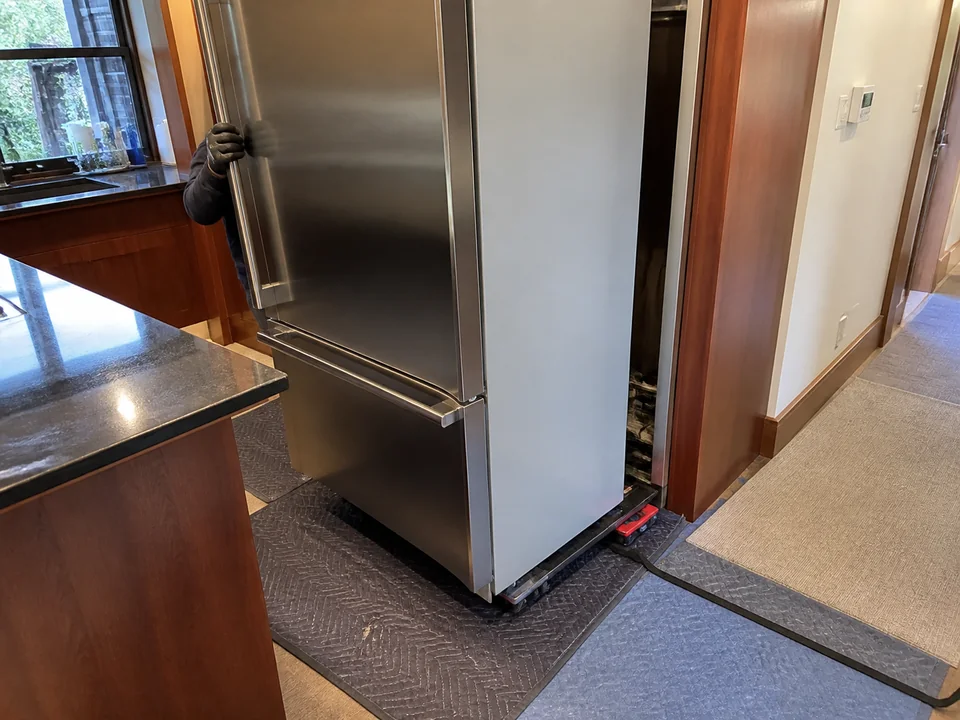
Easing a built-in out without touching the millwork
A Sub-Zero built-in or integrated column is engineered to slide forward for rear service — but only if it's released the way the design intends. The damage happens when someone skips the brackets and levers the cabinet against the surround. Here is the order that keeps your casework intact.
Clear and protect
The unit is emptied, the floor gets a hardboard runner, and both side jambs are padded and taped so nothing rubs the finish.
Check the water line slack
Before anything moves, we confirm the supply tube has enough slack to travel — a kinked or short line is a common reason a pull goes wrong.
Release the panel brackets
Custom door panels and the grille are unfastened at their brackets so the cabinet, not the millwork, carries the load.
Roll forward on glides
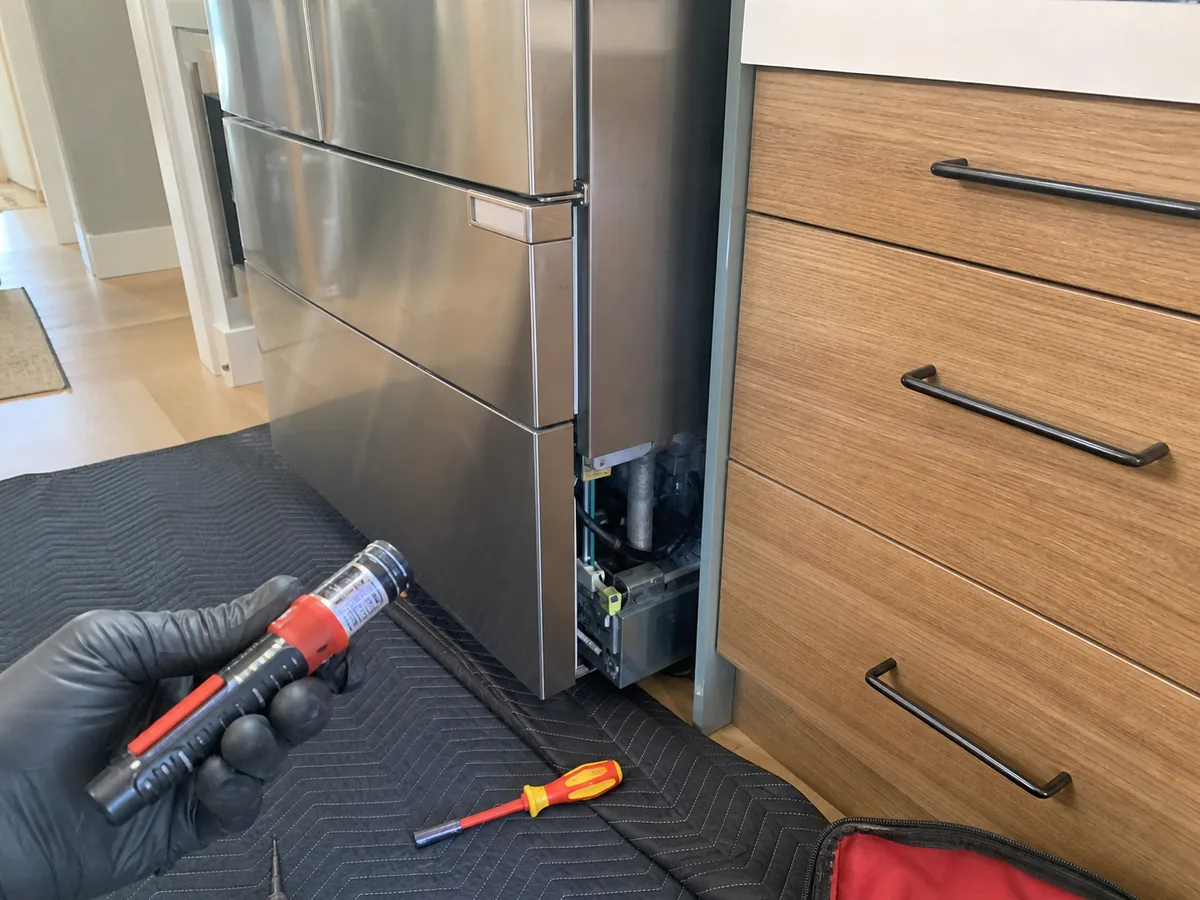
The built-in eases out on its own glides for clearance at the rear — condenser, fans, and sealed-system fittings — without dragging.
Service, then reseat square
After the repair the unit goes back, levelled, with the door reveal and gasket contact checked against the surround.
Verify recovery
We confirm temperature recovery and leave the readings, so you can see the fresh-food side pulling back to setpoint.
What clearance and protection actually look like
An ice maker that drops slow, jammed, or hollow cubes is a good example of why access matters. In plain terms, hollow cubes mean the mold isn't getting enough water before the cycle ends — usually a clogged filter, a tired inlet valve, or a fill tube that's partly frozen or kinked. A logged fill-volume test confirms which one starves the mold. What we can't know before inspection is whether a marginal inlet valve is failing electrically or simply being starved by an upstream restriction; that takes a live measurement on site, and on some columns it's reachable only once the unit is eased forward.
What you're left holding after the repair
A repair you can't see the evidence for is just a charge. On every cabinet-safe job the parts are factory-authorized Sub-Zero OEM, matched to your serial, and the invoice names each one rather than billing a vague "service." Here is the counter-side wording, in plain terms.
Documented after the job
- Parts
- Factory-authorized Sub-Zero OEM, serial-matched
- Invoice
- Each part itemized, not bundled
- Findings
- Temperature readings left with you
- Photos
- Model tag and the failed part
- Labor
- Quoted in writing before work
- Reseat
- Door reveal and gasket contact checked
Exact warranty duration is set on the written estimate. We don't print "lifetime" language we can't stand behind.
A wine column drifting several degrees is evidence, not opinion
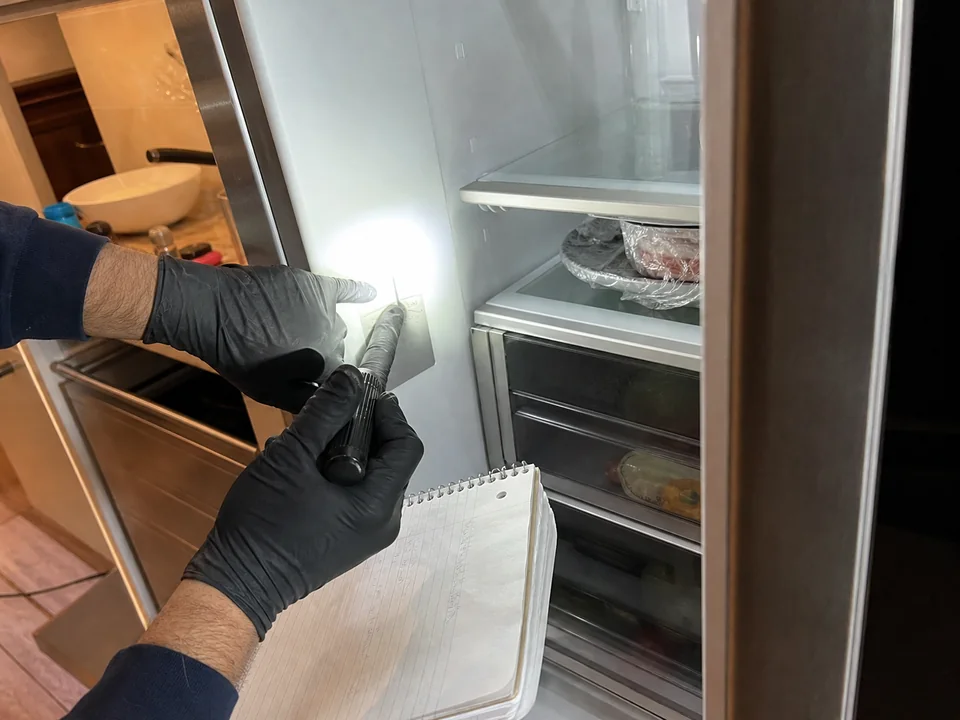
When a wine storage column wanders several degrees off setpoint, we don't take the panel's word for it. The technician collects concrete evidence: temperature readings logged over a full cycle with an independent probe, condenser/evaporator photos, model-tag proof of the exact generation, and factory-authorized OEM fan/gasket/control-board evidence for whatever is replaced. That packet is what backs the repair — so the recommendation is something you can read, not a sales pitch. If the cause turns out to be a thermistor or a stuck damper rather than the sealed system, the evidence shows that too. For the baseline those readings are judged against, the wine storage temperature guide sets out the numbers — and how much drift is too much.
Some answers can't be known before the unit is open
We won't quote a part from a phone description alone. A drifting temperature, a slow ice mold, or a noise at night narrows the field, but whether a fan is failing electrically, a valve is starved, or a sealed system has a slow leak is settled by measurement on site. If a sealed-system fault is suspected on a built-in, that needs EPA-certified verification — a leak test and pressure readings — before refrigerant or a compressor is ever named.
Parts, and why the serial number decides them
The same Sub-Zero model badge can carry two or three different part revisions across its production run. Reading the serial — not just the model — is what keeps us from arriving with a fan or gasket profile that won't seat. These are the categories we serial-match before a cabinet ever comes forward.
Compressors, driers & coils
Compressor, filter-drier, and evaporator/condenser assemblies. EPA-handled, serial-matched, never substituted with generic refrigeration parts.
Evaporator & condenser fans
Fan motors and blades by generation. A warm fresh-food side over a cold freezer is often a single stalled evaporator fan, not a dead cabinet.
Door gaskets & panel hardware
Magnetic gaskets in the correct profile, plus the brackets and grille hardware released during a pull — sized to your exact door and surround.
Inlet valves, fill tubes & filters
The water-path components behind slow, jammed, or hollow ice — replaced only after a fill-volume test names the real restriction.
Thermistors & control boards
Sensors and boards by generation, behind wine-column drift and panel alarms. Confirmed by measurement before naming — the board is last, not first.
Serial match, every time
The serial fixes the revision so the factory-authorized OEM part seats and the door reveal stays true. See the model & serial guide for where to read it.
Why the Park Street district changes the job
The blocks around historic Park Street tell us a lot before we read the model tag. Many of the renovated flats and storefront-adjacent homes there pair modern integrated columns with period casework that won't forgive a careless pull — the surrounds were built tight, often around the appliance, so clearance at the jambs is measured in fractions of an inch. The home age shows up in the routing too: water lines snake through original cabinetry, and the access path to the rear is frequently half the labor. Add the marine air that rolls up from the estuary and the condensers foul faster while gaskets stiffen sooner, which is exactly the mix that pushes a built-in out of its surround for service. Parking and the narrow service entries off Park Street factor into how we schedule and stage the protection before a single bracket is touched. None of that means a unit there is failing early — it means the wear and the access both land in predictable places, and we plan the pull around them rather than improvising in your kitchen.
What we claim — and what we won't
A trust page is the wrong place to inflate credentials. Here is our honest position, stated plainly, so you know exactly what you're hiring.
What we do stand behind
- Cold-side Sub-Zero work only — built-in and column refrigeration.
- Factory-authorized Sub-Zero OEM parts, matched to your serial number.
- Measured diagnosis, a written estimate, and readings left with you.
- Cabinet protection set up before any unit comes forward.
What we will not claim
- No license, insurance, or certification badge stated here unless it has been confirmed — and none is claimed on this page.
- No replacement push when a clean repair will hold.
Where refrigerant work is involved, sealed-system handling is done to EPA requirements — but we name credentials only when they're confirmed, not as marketing. If you need to weigh the larger decision, the repair vs. replace page lays out when the math favors a new unit instead.
What a cabinet-safe Sub-Zero visit tends to cost in Alameda
A front-access fix usually lands in a mid range; a full cabinet pull adds labor for the release, protection, and reseat, shown as its own line. The table lists typical Alameda estimates; your real number is set on site once we know whether a pull is needed.
| Service / symptom | What's included | Price range | Timeframe |
|---|---|---|---|
| Diagnostic / service call | On-site measured diagnosis, model & serial confirmed, written findings (credited) | $115–$185 | Same visit |
| Cabinet pull, protect & reseat (period casework) | Floor and jamb protection, bracket release, glide-out and square reseat — added to the repair | +$120–$295 | Added to job |
| Front-access fix (fan / gasket / valve) | Repairs reachable without pulling the cabinet | $215–$645 | 1 visit |
| Evaporator / condenser fan motor (rear) | factory-authorized OEM fan motor requiring rear access | $365–$685 | 1 visit |
| Door gasket & alignment | factory-authorized OEM magnetic gasket in the correct profile, door reveal reset | $215–$395 | 1 visit |
| Ice maker / inlet valve | Fill-volume test, factory-authorized OEM inlet valve or ice-maker module | $245–$525 | 1–2 visits |
| Sealed system / compressor (EPA) | Refrigerant recovery, leak/charge or compressor, post-repair recovery check | $1,750–$3,450 | 1–2 visits |
Typical Alameda estimates, not a quote.
What determines the final price: whether a pull is needed at all, how tight the surround is in older Gold Coast or Park Street casework, your unit's generation, and whether the fault is one component or a sealed-system question.
Cabinet-safe service questions
Will pulling my Sub-Zero out scratch the surrounding cabinets?
It doesn't have to. We release the panel brackets, lay down floor and jamb protection, and ease the unit forward on its glides rather than dragging it. The goal is rear access with the millwork untouched, and we check the reseat and door reveal before we leave.
My freezer is still cold but the fridge is warm — does the unit have to come out?
Not always. A warm fresh-food side with a holding freezer is often an evaporator fan or defrost fault reachable from the front. We only pull the cabinet when rear condenser, fan, or sealed-system access actually requires it, and we tell you which case yours is before moving anything. The main Sub-Zero repair page covers that fault in detail.
Do you fit factory-authorized Sub-Zero parts or generic equivalents?
Factory-authorized Sub-Zero OEM parts, matched to your serial number. The same model badge can carry different part revisions across generations, so the serial decides which fan, gasket, or control board actually fits. Each replaced part is itemized on the invoice. A worn seal is a good example — see door gasket & seal repair.
How do I get the most accurate answer before booking?
Photograph the rating plate and send the model and serial with your symptom. It lets us confirm part availability and decide whether a pull is needed before the visit. Start at the booking page.
How much does a cabinet pull add to a Sub-Zero repair in Alameda?
In Alameda the cabinet pull, protection, and square reseat add roughly $120–$295 in labor on top of the repair itself, more in tight Gold Coast and Park Street millwork. We only pull when rear condenser, fan, or sealed-system access requires it; a front-reachable fan or gasket needs no pull at all, and we tell you which case yours is first.
Why is a careful pull such a big deal in old Alameda homes?
Many Alameda built-ins sit in original early-1900s casework with almost no clearance, in homes from the Gold Coast to the East End. A dragged or levered cabinet chips finishes, cracks face frames, and kinks the water line. Releasing the brackets and easing it out on glides protects irreplaceable millwork — which is why we budget time for it rather than rushing.
Not sure if your built-in needs to come out?
Tell us what the unit is doing and send a photo of the Sub-Zero rating plate. We'll tell you whether a cabinet pull is even needed for an Alameda visit — and confirm the right factory-authorized OEM part before you commit.
Alameda · Sub-Zero owners
What Alameda customers say
They eased our integrated BI-36 past custom millwork without a single mark. Floor and jamb protection went down before anything moved, and they reset the door reveal so the panel lines up with the cabinets again.
Our old Victorian has period casework with almost no clearance around the unit. They released the panel brackets, slid it out on glides instead of dragging it, and budgeted the extra time to reseat it perfectly. No gouged trim.
The cabinet-safe approach is the real deal in our newer build out by the old base. No rushed pull, no scuffed surround — they cleaned the condenser and checked the gasket while the unit was out, so it was one trip instead of two.