Technical · Sealed system & compressor
Why is my Sub-Zero warming up — is it the compressor?
On a Sub-Zero built-in losing cold across both compartments — or one running long, loud, and hot — the question is whether the sealed refrigeration loop has lost charge or the compressor itself is failing. In Alameda, including the older flats behind Park Street, the marine air drives salt-laden corrosion onto condenser surfaces and tube joints, where slow refrigerant leaks tend to start. A sealed system is a closed, EPA-regulated circuit, so we don't guess: we leak-test, read pressures, and confirm the compressor electrically before naming a part. Call us with the model and serial and we'll tell you what the readings should show.

Is my warming Sub-Zero a failed compressor or a refrigerant leak?
Alameda Sub-Zero Repair proves it with an EPA leak trace plus a low-side and high-side pressure read, then checks the compressor windings and start relay against spec, so a cheap relay is never quoted as a compressor. We work Fernside and the 94501 waterfront; call (510) 390-9712 with your model.
Sealed-system symptom matrix
This table is the shape of a diagnosis, not a self-fix. The point of the "confirmation test" and "false-positive" columns is to keep an expensive sealed-system or compressor repair from being named on a hunch. Every refrigerant line below is EPA-handled.
| Symptom | Possible component | Confirmation test | False-positive to avoid | Repair path |
|---|---|---|---|---|
| Both compartments slowly warming, unit runs constantly | Refrigerant undercharge from a leak | EPA leak trace + low-side / high-side pressure read | Not a fan or defrost fault when both sides drift together | Locate leak, repair joint, evacuate, weigh in OEM charge |
| Compressor hums then clicks off, won't run | Start relay / overload or seized compressor | Winding resistance + start-component bench check | Not always the compressor — relay fails far more often | Replace relay/overload; compressor only if windings prove bad |
| Condenser area very hot, short-cycling | Overcharge, restriction, or condenser airflow loss | Pressure profile + condenser airflow inspection | A choked coil mimics a sealed-system fault but needs no part | Clean/clear airflow first; open system only if pressures confirm |
| Frost or oil film at a tube joint | Pinhole refrigerant leak (often corrosion-driven) | Electronic leak detector + bubble test at suspect joint | Surface condensation is not the same as an oil-stained leak | Recover charge, braze or replace joint, drier, recharge |
| Ice maker slow, jammed, or hollow cubes | Water-path restriction; rarely the sealed system | Logged fill-volume test before touching refrigeration | Don't open a sealed system for an ice fault — it's the water path | Clear inlet valve / filter / fill tube; verify cube formation |
| Wine column drifting several degrees off setpoint | Thermistor, damper, or partial sealed-system loss | Independent probe trace vs. panel + pressure read if needed | Don't trust the display reading alone as proof of charge | Replace sensor/damper first; sealed work only if pressures fail |
| Control board / thermistor / display alarm with warm box | Sensor or board, not necessarily refrigeration | Service-mode read + resistance check against spec | Board is the last suspect, not the first — verify sensors first | Replace proven sensor or board by generation; document readings |
What you can check — and where it has to stop
There is a short list of things a homeowner can safely confirm before calling, and a hard line past it. Safely: note whether one or both compartments are warming, whether the unit is running nonstop, and whether the condenser area feels unusually hot; you can also vacuum accessible condenser dust on a unit that's unplugged, since a choked coil mimics a sealed-system fault and often needs no part at all. Read the rating plate and have the model and serial ready.
No DIY on refrigerant, gas, electrical, or the control board
The sealed loop is a pressurized, EPA-regulated circuit — there is no homeowner-serviceable point on it, and "adding a can of gas" without a leak repair is both illegal handling and a guaranteed repeat failure. Compressor start components carry stored electrical charge, and the main control board is delicate and easy to mis-diagnose. Leak detection, pressure readings, recovery, brazing, evacuation, recharge, and any compressor or board decision are technician work, done with recovery equipment and a meter — not a kitchen task.
The honest reason for the line is simple: the failures that matter here can't be confirmed by feel. A wine column that has drifted several degrees, for example, looks identical from the kitchen whether the cause is a cheap thermistor or a slow sealed-system loss — only a probe trace and, if needed, a pressure read tell them apart. So the safe homeowner job ends at observation and a clean condenser; everything inside the loop starts with measurement.
The "trained tech" half of that line is a checkable federal credential, not a slogan: the person who puts gauges on your loop must hold EPA Section 608 certification, and ours carry the Universal level. Because a sealed-system visit on the Island means recovery equipment crossing a bridge or the tube, the credential and your generation's charge type are confirmed at dispatch — and the card itself is shown in your kitchen before the work is approved. How to verify any technician's 608 card documents exactly what to look at, ours included.
"My wine column is off by a few degrees"
In plain language: a Sub-Zero wine column is supposed to hold its setpoint within a tight band, so when it reads several degrees warm or swings between racks, the cabinet isn't moving heat the way it should. That can be a thermistor reporting the wrong temperature, a damper stuck part-open, an evaporator not getting airflow, or — least common but most serious — a sealed system slowly losing charge. We confirm it the same way every time: an independent probe logged against the unit's own display over a full cycle, so we can see whether the box is actually warm or just reading wrong.
The honest limitation: from the readings alone we can narrow it, but we cannot know before opening the unit whether a borderline sealed system is leaking at a joint we can reach or at one buried in the condenser pack. Until the pressure read and leak trace are done on site, "it might be the sealed system" is a suspicion, not a diagnosis — and we won't price it as one.
Model-family notes for sealed-system work
Sealed-system access, charge type, and component layout vary by Sub-Zero family. The notes below are about where the work happens, not invented code meanings. Exact charge weights, pressures, and any service codes are confirmed on the rating plate and service literature for your unit — we mark those "verify by model/serial" rather than print a number we can't stand behind.
Built-in dual refrigeration
Two independent sealed systems share the cabinet, so a leak or compressor fault can sit on one circuit while the other holds. We isolate which loop before opening anything. Exact charge — verify by model/serial.
Professional refrigeration
Higher-capacity sealed systems with the condenser working hard behind the grille; corrosion-driven joint leaks show here first in marine air. Pressure targets — verify by model/serial.
Integrated column fridge / freezer
Single-system columns where access is tight inside cabinetry; a slow charge loss reads as steady warming, not a hard fault. Component layout — verify by model/serial.
Wine storage columns
Smaller sealed circuits where a partial loss shows as drift, easily mistaken for a thermistor. We separate the two by probe trace first. Setpoint band — verify by model/serial.
Undercounter refrigeration
Compact systems where the compressor and start components are packed close; relay and overload faults are common before a true compressor failure. Start-component spec — verify by model/serial.
Service codes & alarms
A display alarm narrows the search but doesn't name a sealed-system part on its own. We read it in service mode and confirm by measurement. Code meaning — verify by model/serial.
The evidence behind a sealed-system call
When a display alarm or a "control board, thermistor or display alarm" complaint comes in with a warm box, we don't reach for the most expensive part. We build a record: temperature readings logged over a cycle, condenser and evaporator photos, model-tag proof of the exact generation, and factory-authorized OEM fan, gasket, or control-board evidence where the fault points there. Only when those readings actually fail does refrigerant work get named — and even then it's the leak trace and pressures that decide it, not a guess.
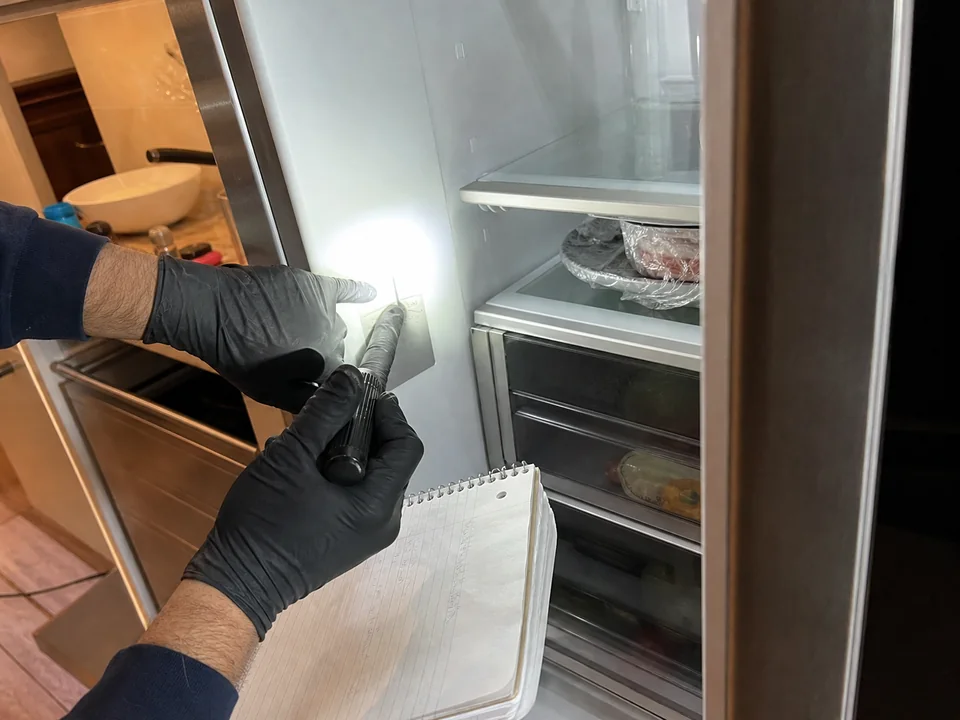
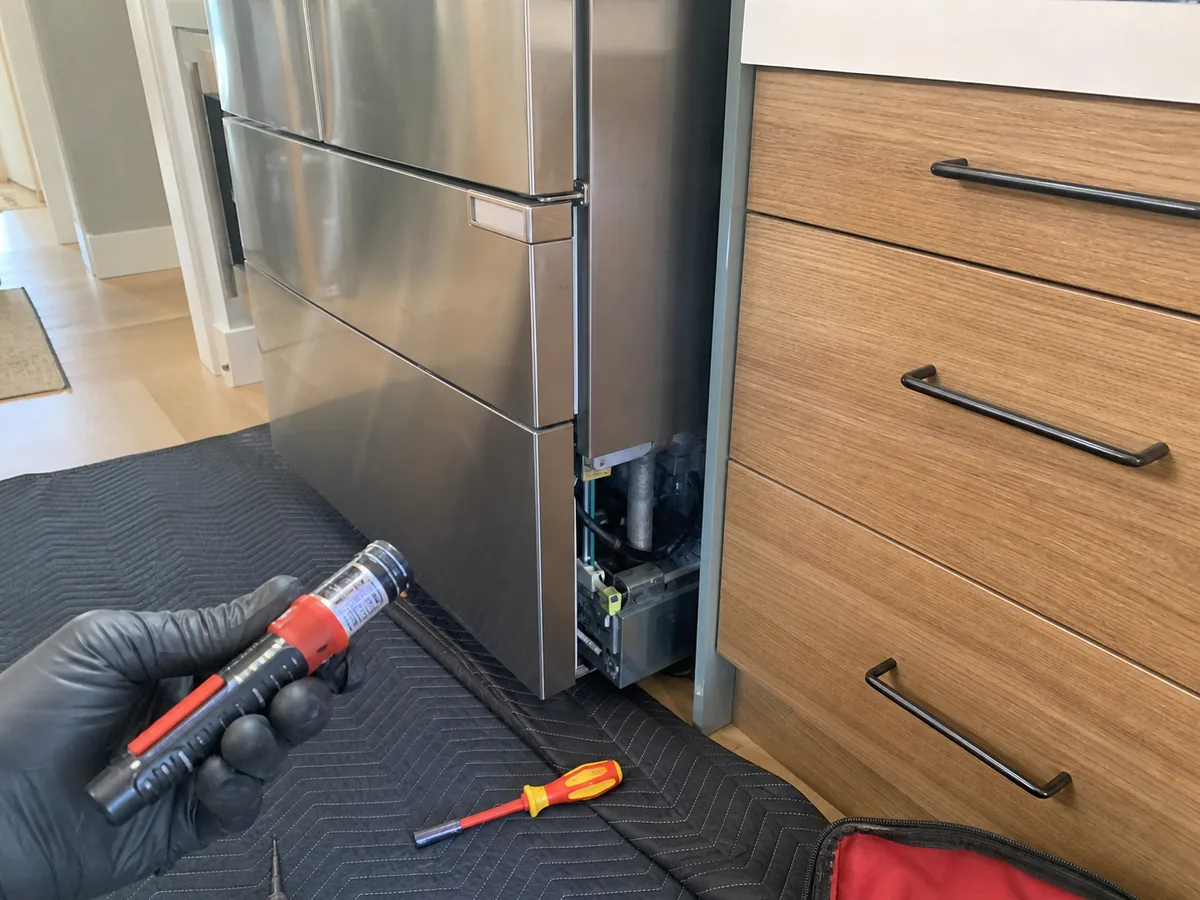
What historic Park Street does to a sealed system
Service along historic Park Street and the residential blocks behind it is shaped by the buildings as much as the appliance. Many are older flats and converted Victorians where a built-in was fitted into period casework with minimal clearance, so the condenser sits close to the wall and fouls faster, and the unit has to be eased out on glides rather than pulled — which adds time to any job that needs rear sealed-system access. The home age matters too: original wiring and tight kitchens mean we plan the route and power before we touch the loop. And the appliance mix skews toward flagship built-ins and wine columns, exactly the units where a careful sealed-system diagnosis pays off instead of a quick part swap.
Climate is the constant. Three blocks from the estuary, salt air and fog cycles drive corrosion onto condenser fins and tube joints, and that's where slow refrigerant leaks tend to start — a pinhole at a corroded braze rather than a dramatic failure. Over toward Webster Street and the West End, the same marine load shows up on undercounter and column units packed into narrow waterfront cabinetry, where access is half the battle and the start relay often fails before the compressor truly does. None of this means a unit is finished; it means the wear is predictable, and we look where the air does its damage first.
Period casework, tight access
Built-ins in older flats with minimal clearance; condensers foul fast and rear sealed-system access takes a careful pull.
Waterfront cabinetry
Undercounter and column units in narrow surrounds; marine air drives relay and corrosion faults before true compressor failure.
Newer column-heavy builds
Panel-ready columns where slow charge loss reads as steady drift in the open, humid air off the bay.
How a Sub-Zero sealed-system fault is confirmed
A sealed-system call is the most expensive on a Sub-Zero, so it is the one we prove hardest before naming. These five steps are the same on every Alameda visit, and none commit you to refrigerant work until the evidence justifies it.
Rule out the simple faults first
We confirm the condenser, fans, and defrost are healthy, because a fouled coil or a stalled fan mimics a sealed-system loss — common on Alameda's salt-air blocks.
Log the cabinet against an independent probe
An independent probe is logged in the compartment over a full cycle and compared with the panel, so the display alone never decides the call.
Trace for a refrigerant leak (EPA)
An electronic leak search and a pressure read locate whether refrigerant has been lost and where, before anything is opened.
Test the compressor and start components
Windings, start relay, and overload are checked against spec, so a $200 relay is never quoted as a compressor.
Repair, evacuate, and weigh the charge
If sealed work is justified, we braze the leak, fit a new filter-drier, evacuate, recharge by weight for your generation, and log the temperature recovery.
What sealed-system work tends to run in Alameda
Sealed-system and compressor repair is the expensive exception on a Sub-Zero, priced separately because of refrigerant recovery, brazing, evacuation, recharge, and the labor of reaching the loop on a built-in. The table lists typical Alameda estimates; your real number is set on site once the pressures are read.
| Service / symptom | What's included | Price range | Timeframe |
|---|---|---|---|
| Diagnostic / service call | On-site measured diagnosis, model & serial confirmed, written findings (credited to the repair) | $115–$185 | Same visit |
| EPA leak trace & pressure diagnosis | Electronic leak search and pressure read against spec for your charge | $195–$385 | 1 visit |
| Start relay / overload / capacitor | Start-component test and replacement — rules out a false compressor call | $235–$445 | 1 visit |
| Condenser / fan tied to high-side load | Fan motor and airflow correction that can mimic a sealed fault | $365–$685 | 1 visit |
| Leak repair, filter-drier & recharge (EPA) | Braze repair, new drier, evacuation and weighed recharge, recovery check | $1,250–$2,400 | 1–2 visits |
| Compressor replacement (EPA) | Recovery, compressor, drier, evacuation, weighed charge, verification | $1,750–$3,450 | 1–2 visits |
Typical Alameda estimates, not a quote.
What determines the final price: whether it's a leak repair or a full compressor change, how tight the built-in pull is, the charge type for your generation, and whether a fouled condenser was the real culprit all along. When the estimate climbs against an older cabinet, repair vs. replace walks the math.
We do not guess on the sealed system
Refrigerant and compressor calls are proven, not assumed
No refrigerant goes into a Sub-Zero without a leak first being found and repaired, and no compressor is named until its windings and start components are checked against spec. We won't "top off" a sealed system, we won't swap a control board on a hunch, and we won't quote a compressor when a $200 relay is the actual fault. The decision rests on the leak trace, the pressure read, and the meter — documented and left with you. If those don't justify the work, we tell you that too.
Not sure this is even a sealed-system fault? Start with the not-cooling diagnostic to separate a fan or defrost issue from a refrigerant one, or read what a display alarm or service code actually narrows down. For the full service overview, see the main Sub-Zero repair page, and when the estimate is high, repair vs. replace walks through the math. Ready to book? The booking page shows what to send so we can check parts before the visit.
Have the model number? Read it to us first.
The serial fixes the charge type and compressor for your generation, so we can tell you what the pressures should read before a technician is on site. Calling is the fastest channel.
Sealed-system questions from Alameda owners
Both my Sub-Zero compartments are warming — is the compressor dead?
Not necessarily. Warming on both sides can be a failed compressor, but it's just as often a refrigerant leak, a stuck start relay, or a fouled condenser overworking the system. We confirm with a leak trace, a pressure read, and a meter before naming the compressor. A start-relay fix runs $235–$445; a compressor is $1,750–$3,450.
Does Alameda's salt air shorten a Sub-Zero compressor's life?
It works on the condenser more than the compressor. Salt and fog corrode the condenser coil and fins, so the sealed system runs hotter and harder to hold temperature, which over years stresses the compressor. Keeping the condenser clean — important on the waterfront blocks of Fernside and the Gold Coast — is the cheapest protection there is.
Will you just top off the refrigerant?
No. A sealed system that has lost refrigerant has a leak, and adding gas without repair is against EPA rules and only delays the failure. We find and fix the leak, replace the filter-drier, evacuate, and recharge by weight. Leak repair with recharge runs $1,250–$2,400.
Is a sealed-system repair worth it on an older built-in?
Sometimes. On a sound 10–15-year cabinet, a $1,250–$2,400 leak repair usually beats a $9,000-plus built-in replacement. On a 20-plus-year unit with other failing parts, replacement deserves a look. We give you the pressures and the honest math; repair vs. replace walks through it.
How long does sealed-system work take?
Usually one to two visits. A leak trace and pressure diagnosis is done first; the repair — braze, new drier, evacuation, and a weighed recharge — often needs a return once the right parts and charge for your generation are confirmed. We verify temperature recovery before closing the job.
Can you tell over the phone if it's the sealed system?
We can give a direction from your model, serial, and symptom, but a real answer needs an on-site leak trace and pressure read. Read us the rating plate and we'll tell you what the pressures should be for your generation and whether a same-day window is realistic in Alameda.
Alameda · Sub-Zero owners
What Alameda customers say
I was braced for a full compressor replacement. They put gauges on it first, found one circuit was starved rather than the compressor failing, and did a proper leak test before quoting. The honesty saved me a much bigger bill.
Sealed-system work done properly — refrigerant recovered and recharged to spec, with the technician showing his EPA card on arrival. They re-checked the freezer recovery after the repair, and it holds rock steady at zero now.
They isolated which of the two sealed systems had actually failed before opening anything up, so the repair targeted the right circuit and the freezer side stayed untouched. Precise work, nothing wasted, and a clear written quote first.